
📍Location
52.346448, 4.849093
I first discovered Huis te Vraag through a photograph I came across somewhere online. Intrigued by what I saw, I started searching for the place and learned that it was hidden in Amsterdam — only about 25 kilometres from my home.
Still, almost a year passed before I finally visited.
Behind the wrought-iron entrance gate, the path slowly rises towards the former aula. The moment I entered, my first thought was simply: wow. How could a place like this exist in the middle of the city?
The sounds of Amsterdam seemed to disappear behind me. Instead, I found narrow paths, flowers, insects and old graves slowly being reclaimed by ivy. Parts of the cemetery feel almost completely overgrown, while the paths and vegetation are carefully maintained by volunteers. That balance between wildness and care is what makes Huis te Vraag so beautiful.

A place where travellers asked the way
The history of Huis te Vraag began long before this became a cemetery.
In the Middle Ages, the road between Haarlem and Amsterdam passed through a landscape of water, reed beds and marshes. Near the Schinkel stood a small ferry house and inn where travellers could eat, spend the night and ask for directions. A sign carrying the words te Vraghe supposedly told passers-by that information could be found there.

A map from 1790 that already shows Huis ter Vraag.
According to legend, Maximilian of Austria stopped here during a pilgrimage to Amsterdam in 1486 or 1489 and asked the way. Whether that truly happened is uncertain, but the story gave the place a name that would survive everything built upon it.
Around 1618, an Amsterdam cloth manufacturer built a country house beside the Schinkel and named it ’t Huys te Vraghe. Farms, a mill, a shipyard and a cotton-printing works gradually appeared around the house. For centuries, it served as a familiar landmark in the surrounding landscape.

View of the Huis Te Vraag inn on Sloterweg, Rembrandt van Rijn, c. 1652.
By the nineteenth century, the textile industry was in decline and the house became too expensive to maintain. In 1890, after standing beside the Schinkel for almost three centuries, it was demolished.
The house disappeared, but its name remained.

Family portrait in front of Huis te Vraag in Amsterdam, anonymous, 1880–1920.
From country house to cemetery
One year later, contractor Pieter Oosterhuis transformed the land into a private Protestant cemetery. The rubble of the former country house formed part of its foundation. Because the surrounding peatland was too wet for burials, around 50,000 cubic metres of sand were transported by ship to raise the terrain.
Oosterhuis planted trees and flowering shrubs and built an aula with an adjoining caretaker’s residence. A carved stone from the demolished country house was incorporated into one of its walls, preserving a small part of the former Huis te Vraag.
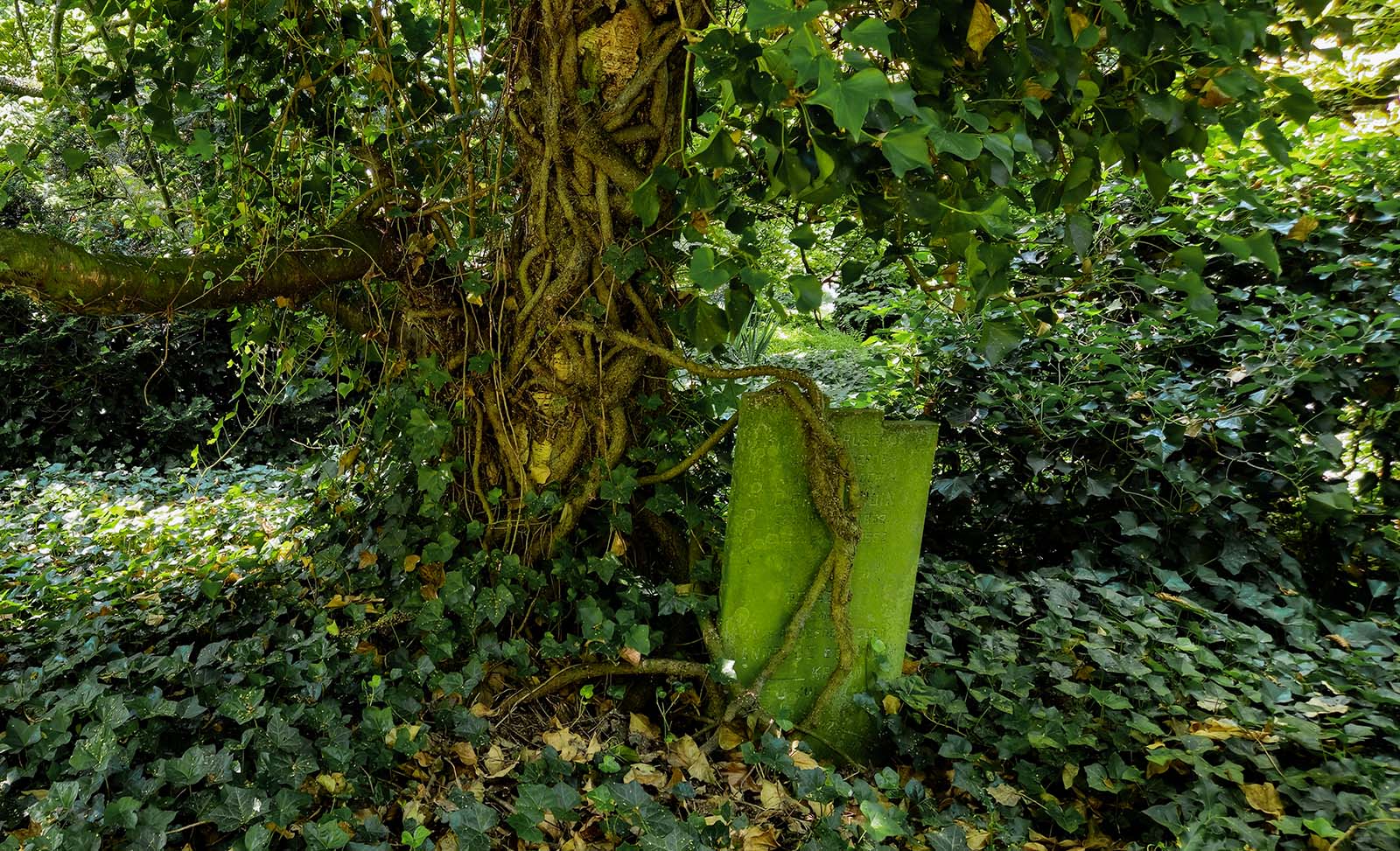
Between 1891 and 1962, an estimated 12,000 to 16,000 people were buried here, sometimes four or five deep. The true number will never be known. Jewish people, those living in hiding and anonymous victims of the Hunger Winter are believed to have been buried here without being officially registered.
When there was no space left, the cemetery closed. New burials were no longer permitted and the grounds slowly became overgrown and almost forgotten.
A garden for the dead
In 1987, artist Leon van der Heijden and his wife Willemijn moved into the former aula and began caring for the neglected grounds.
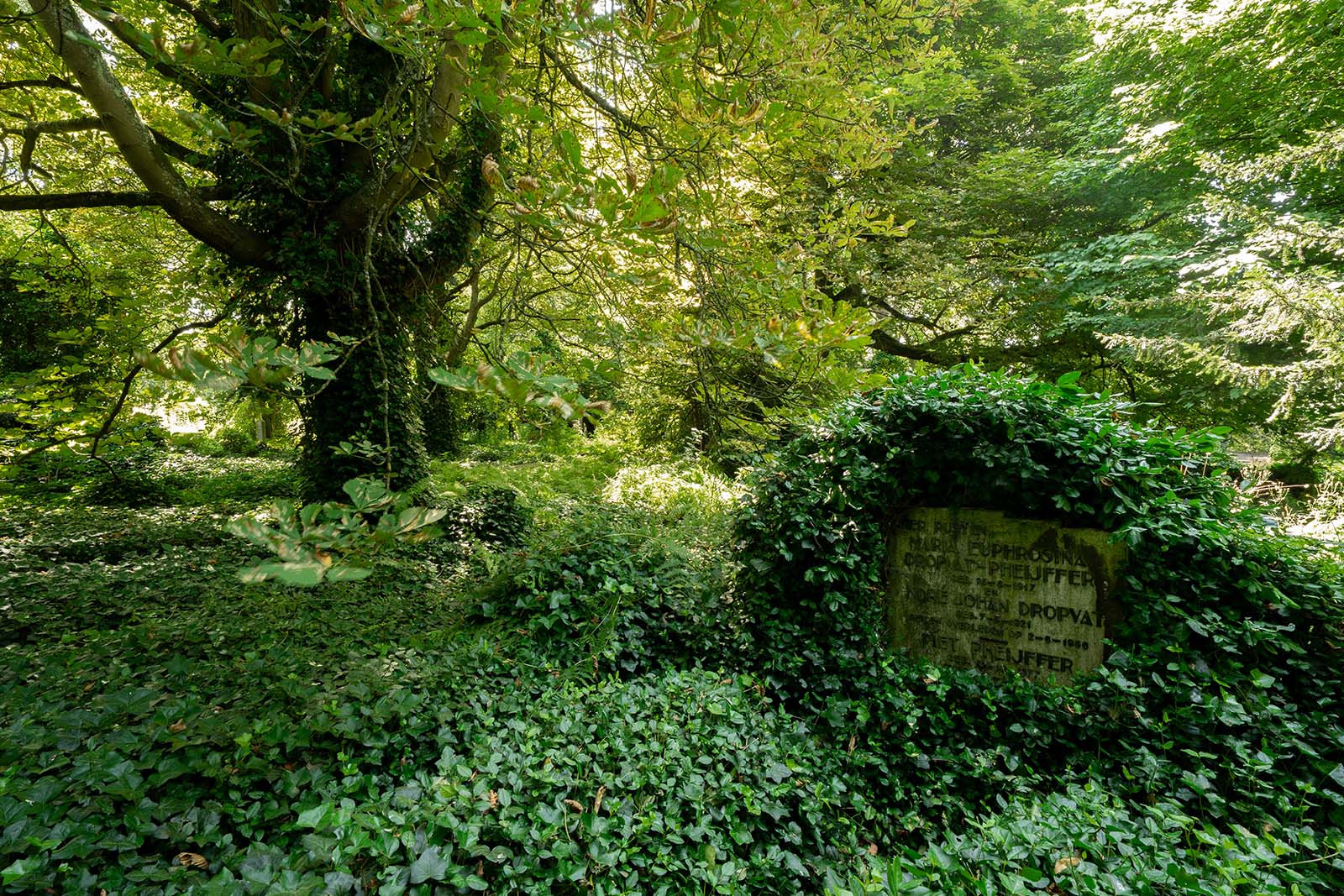
Rather than removing its wild character, they worked with it. Paths were cleared and the ivy was kept under control, but nature was allowed to remain part of the cemetery. Over time, Huis te Vraag became something between a burial ground, a garden and a work of art.
That balance is still visible today.

The cemetery is not an uncontrolled wilderness. Volunteers keep the paths accessible, trim the hedges and prevent the vegetation from swallowing the graves completely. Yet they also allow flowers, insects and ivy to find their place among the monuments.
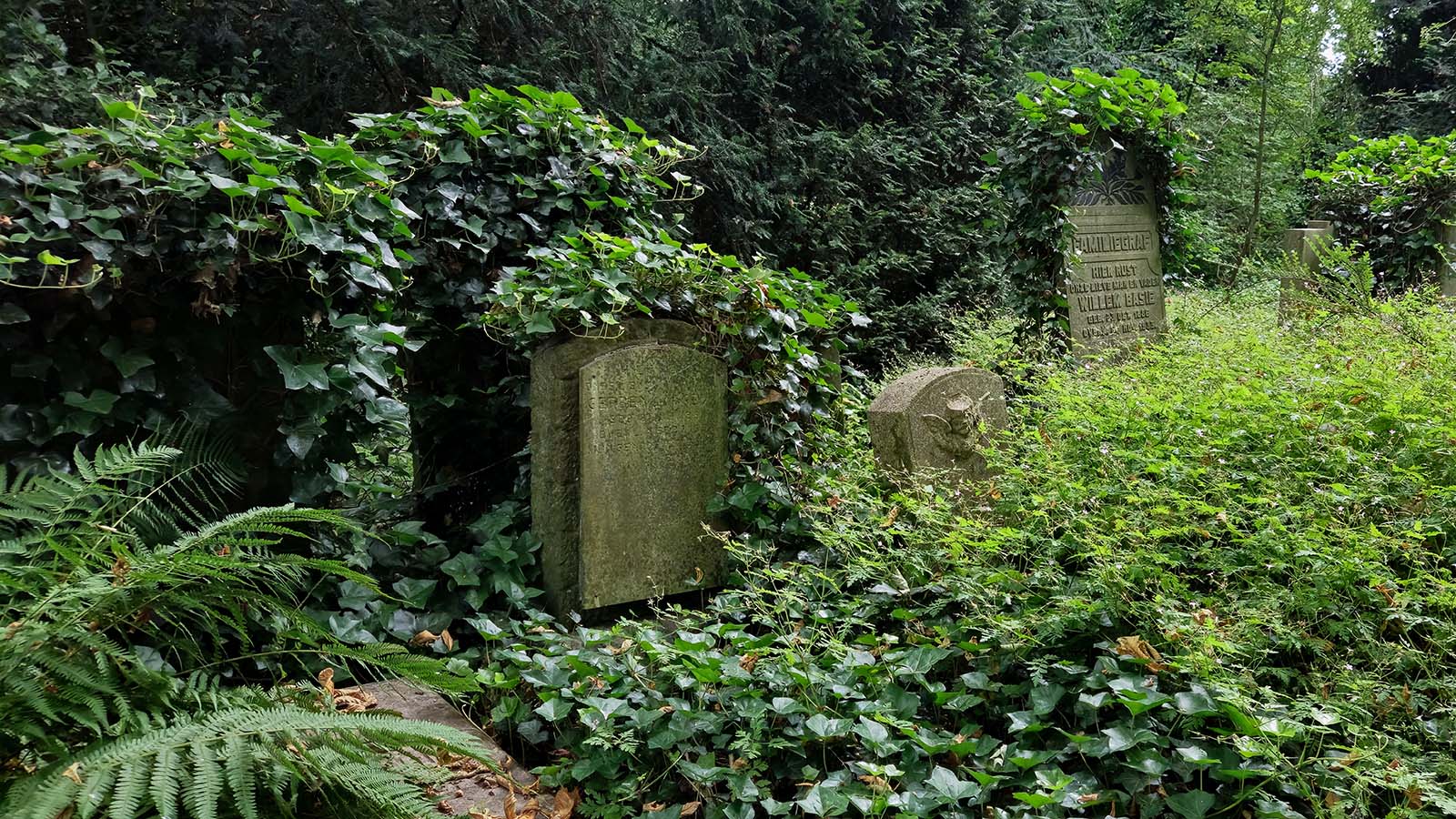
Some gravestones remain clearly visible. Others have almost disappeared beneath a thick green covering, with only part of a name or date still showing. Those overgrown graves stayed with me most. They feel forgotten, but at the same time protected by the nature surrounding them.
A hidden world inside the city
During my visit, it was almost completely silent. I encountered only one other person. It felt strange to realise that the streets and buildings of Amsterdam were so close, while inside the cemetery I seemed to have entered another world.
The old inn has disappeared. The country house was demolished. The cemetery closed more than sixty years ago. Yet the name Huis te Vraag survived.
Perhaps that name has become even more fitting over time. What began as a place where travellers could ask for directions is now a place that leaves you with entirely different questions — about the people buried here, the lives they lived and what remains when names and stories slowly disappear beneath the ivy.
When I walked back through the gate, one thought immediately came to mind:
I want to photograph this place in every season.